Play Battle for the Presidency safely

COVID-19 – safety hints:

With the shifting waves of the pandemic, there is no way to tell whether you will be able to sit 30 students in a classroom for the game, on the day you have planned for, or whether certain restrictions will have been placed on how teaching can take place. In the following post, I have tried to show the different ways you can create a safer playing area for Battle for the Presidency, so you can decide realistically whether it is possible and safe to play the game with your class.

Battle for the Presidency is designed to be played by up to 30 students divided into smaller groups .You can keep the maximum group size to five. If you need groups that are smaller than five students, you will have to accept a lower total number of players.

Playing pieces – cards and boards:

The game is intended as a print, cut, and play game. So in extreme situations, you can instruct a member of each of the groups to print their part of the playing pieces and cut them out themselves.

However, if you as a teacher meet the students in person anyway, there is no reason you should not print and handle the material yourself and hand it out to the students. I recommend sorting everything in advance and placing it in an envelope or plastic folder for each table, so students don’t handle each other’s material.

The playing area:

The most extreme and safest course of action would be to have the players for each region placed in their own group room, and HQs split up in one room each. It is definitely possible to conduct all communications digitally and not actually move candidates to any states during the game.

Note, however, that there will be long quiet spells in the regional offices, if they cannot see the activities of their neighbours and the HQ from a distance, but are left in isolation between their actions. Also, candidates still have to visit states in the terms of the game – even if they do not move physically, so you will have to make it very clear to everybody what the candidates are doing as a game action. So this solution is possible, but not ideal.

The optimal way for the game experience is simply to use a significantly larger room than you usually would. If you follow the layout of this chart, you can optimize the distance between student groups at all times. By using visitor chairs, it is still clear, when someone visits a state or a region, and you have a way of ensuring their distance from the other group, which standing at a distance does not ensure to the same degree.
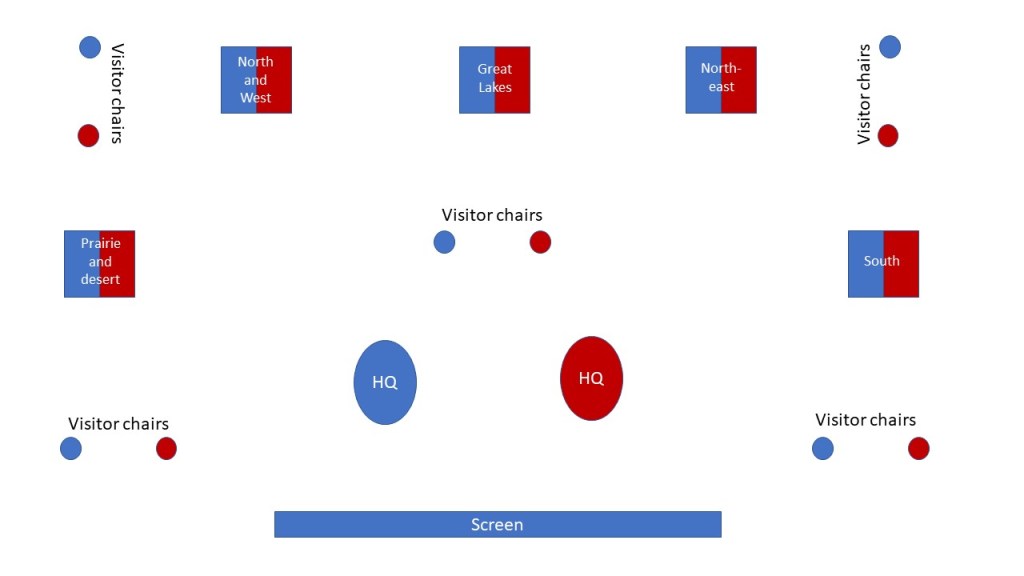
You can download a PDF file showing set-up here:

Play safely, 

Malik

PS. Remember you can buy the game at Teachers Pay Teachers.
“Battle for the Presidency – 2020” is now finished

What is it:

“Battle for the Presidency” is a mix between a traditional boardgame and a role-playing game. The activites of the game are comparable to what goes on in traditional boardgames about elections, but the game is designed to let up to 30 students play different roles that are all important for the outcome of the game. It takes about three hours to play.

How to get it: It can be bought on in my Teachers Pay Teachers store  or ordered by mail at (malikhyltoft[at]gmail[dot]com).

Since I sell it as a downloadable classroom game, you have to factor in extra time for printing, cutting and packing. The game is downloaded or sent as a zip file, made using Winzip, which Windows is now able to open. Either double click and it should open or right click and choose open with Windows Stifinder/Explorer.

The playing field keeps shifting: Usually, you want a game to be as presentable as possible, and give a good tactile feeling for the buyer, but in this case I have valued speed over thoroughness. Speed is of the essence.

I have been working on the game off and on for a month, adding content only in the last two weeks. And yet, the playing field has shifted significantly. It is not so important with the unending scandals – Trump said this, Trump knew that. The scandals influence the public to a certain extent, but they usually only add on to a narrative we know already. Actual events like wildfires, hurricanes, police killings, and so on feel much more pertinent, and yet seem to have little actual effect on the polls.

Anyway, the game is now ready: it can be bought here for $10 or ordered directly from me for 100 DKK at (malikhyltoft[at]gmail[dot]com). Since it is my only new product this year, I will not reach the minimum VAT-level, so you will get an invoice for any accounting with all relevant information, and I will of course make sure my income is tax registered, but there will be no VAT added to your bill.

So, what is new?

Vice-presidential candidates are more active. The vice-presidential candidates still only have one action each round (the presidential candidate has two), but they have a greater scope. Some speeches have to be given by the vice-presidential candidates, and there is the option of either backing up whatever their presidential candidate does, to give them a bonus, or of doing their own thing.

Cannabis is not an issue, neither are Tea Party, Federal Land, Standardized Testing, War on Terror or Hispanics. This is not to say that they are not relevant issues in American politics, but they have been removed from the game to paint a picture of the debate that is as up to date as I could make it. So QAnon, Anti-Fascism, School Vouchers, Student Loans, America First, Smaller State, Protect the little guy, and Clean Government have taken over in the issues department. Some of the old issues are still touched upon in the event cards, though. Black Lives Matter and police brutality figure more prominently this time, but were already included in 2016.

Republican HQ has more cards. There is also one more card for the Democrats and one for the event cards, but the big difference is with the Republicans. Actually, the Republicans and the Democrats will get to play almost the same number of cards during a game with a slight edge in favor of the Republicans. The real difference is that the Republican card play could go anywhere – they will only get to play about half of the cards in the stack. The corresponding number for the Democrats is two thirds.

Unpredictability is included. I have included an unpredictability chart that the teacher can use, before states are declared every round.

The chart was invented in a limited way in March 2017, when I was going to run a game at G.F. Abela – Junior College in Valletta, Malta. At this point in time, it was of course clear that Trump had won the election of November 2016, and the game I had made, which had been quite consistent in predicting a Clinton victory, was off the mark. So, I added a random factor that would make votes for Trump pop up in a random region five out of six rounds, but without any way to control it. This simulated the dark numbers – all the people who were not asked by the polls or would not admit to being Trump supporters, but would eventually vote for him on election night.

For 2020, that chart has been included in the actual rules, but they also include random flares of COVID-19 and widespread protesting against police brutality (or possibly for some new reason).

Have fun! I hope loads of students will have wholesome fun with Battle for the presidency 2020, and I hope their curiosity will awaken so much that even you have to hit the books to answer the questions.

If you have any questions, I’ll answer mails as fast as possible, but please check for updates here first.

Enjoy! And, if you come across an election; remember to vote.

Battle for the Presidency 2020

I am currently working on a follow up to my class-room game, Battle for the Presidency 2016.

“Battle for the Pesidency” is a mix between a traditional boardgame and a role-playing game. The activites of the game are comparable to what goes on in traditional boardgames about elections, but the game is designed to let up to 30 students play different roles, that are all important for the outcome of the game. It teaches students about the American election process, the role of the states and the candidates and issues in the present election. The game can be run in 3-4 hours and is aimed at students in grade 9-12. 

In terms of outreach, the 2016 version clearly outperformed my expectations. In October 2016, over 200 teachers in Denmark, Norway, Faroe Islands and Greenland received the game, and presumably most of them played it with their English classes.

In the US, the game was shared via the Teachers Pay Teachers platform and was sold about a dozen times. The US was not the intended target, so even selling any games at all was a good result. Even better, the game has kept selling in a trickle ever since.

The feedback I got was singularly positive. Teachers who did not like the game would, of course, not spend the energy to write about it in most cases, so this gives no indication of how large a proportion liked the game. On the other hand, I received a large proportion of positive feedback from teachers who enjoyed playing the game with their classes, and  only a few questions concerning the actual game play, so I feel that enough people benefited from the effort to make it well worth the effort. All questions regarding gameplay will be taken into account with regards to the 2020 edition.

Now a new election looms!

The 2020 election is really too dirty and too unpredictable to correctly portray in a game – so if the game was meant as a simulation of what is to come, it would be impossible to do properly. However, the main purpose of Battle for the Presidency is to teach students about the electoral system, the states, the major parties and current issues in US politics. And this can still be done!

Furthermore, I am convinced that the American democracy is strong enough to still exist and still support this election system, even if this year’s campaign ends up making a mockery of the dreams of both founding fathers and civil rights heroes. And I believe that teaching our students about how the system is supposed to work will help them assist in upholding the system (or the democratic system of their home country) in years to come.

So, Battle for the Presidency 2020 is a thing. I am finishing the last touches to rules, new cards and state information this week and will make it as presentable as I can next week. Possibly, I can squeeze in a play test before it is launched, but since the 2016 edition was well and truly tested, we will just have to go on faith, if this does not work out. I am planning to launch the game on September 15, 2020.

I am not working as a teacher any longer, so there is no one paying my salary while I do this. For this reason, I hope that people will buy it from Teachers Pay Teachers or directly from me. I will sell a download for $10 on TPT (https://www.teacherspayteachers.com/Store/Danish-Gamification) or directly via mail (malikhyltoft[at]gmail[dot]com) for 100 DKK. I won’t make a killing from it, but for an unemployed game-designer every dollar counts. 

If you are wondering about the augmented price for buying directly on mail, it is simply because I want to dissuade people from using the direct method, as I would like to build up my TPT shop and also, if there are as many requests as the last time, it would be hard to keep track of everyone. Since some Danish schools are barred from making purchases outside the EU, however, the option needs to be open.

Copyright: I am not going to copyright the product. I have no way of upholding any copyright anyway. If you want to buy a copy for every teacher who uses the game – I’d be thrilled. If you buy a copy for your school and everybody uses it, I would deem it fair. If on the other hand, you distribute it freely to everybody after purchase that would be disrespectful to the work put into the project.

Have fun – or chills. It is 2020, after all.

Sweeping Trump victory in Valletta – or how to get more realistic results in Battle for the Presidency

While I get reports of good learning experiences from students who play Battle for the Presidency, the game has a strong tendency to proclaim Hillary Clinton as the winner. This reflects the general analysis prior to the election, but when the game is played after the election, it seems a bit odd that the wrong outcome is highly predominant.

When I played the game with one of my Danish upper secondary classes and a Maltese junior college class in March, I made a few modifications.

In the following text, I will sum up the modifications I chose to implement for the game, along with a short motivation for each.

1: Secret Trump Voters and Money for Hillary

Since I wanted Trump to have more than just a fighting chance, I added an extra feature. This illustrates the inability of the polls to foretell the number of Trump voters, and at the same time hints at the superior economic capability of the Hillary campaign.

At the beginning of every turn, beginning at turn two, both campaign managers roll a die. Results can be seen on the following chart:

Die roll Area Democrats Republicans
1 None No effect No effect
2 Northeast Regional office gains 3M$ Republicans gain 1 vote in all states in region
3 South Regional office gains 3M$ Republicans gain 1 vote in all states in region
4 Great Lakes Regional office gains 3M$ Republicans gain 1 vote in all states in region
5 Prairie and Desert Regional office gains 3M$ Republicans gain 1 vote in all states in region
6 North and West Regional office gains 3M$ Republicans gain 1 vote in all states in region


2: Added funds for the regional offices

A group of teachers in a neighboring town ran five games in a row and tweaked the rules a bit every time. They found that the game was faster and had more activities for the regional offices, if they had a budget and funds to work with.

So the regional managers got 5M$ each in their war chest at the beginning of the game and an income of 2M$ each turn.


3: Fox and CNN

Since I was running a game for 54 students, there was precious little for each student to do, if we did not add extra activities. Each HQ was enlarged with two extra Communication Experts, so the Campaign Manager had extra eyes and ears, which worked well.

As a more significant game changer, two groups of students were asked to act as news crews for Fox News  and CNN respectively.


In order to make the tasks of the news crews more relevant, they were given notice in advance of the upcoming event, and would then interview representatives of the two parties before and after the reading of the event card.

The news crews were instructed to focus on regions with little action, and in that way provided extra activity without slowing down the game.

Some time had to be taken out for short broadcasts at the end of each turn, however.


All in all, Trump won a comfortable, but not a landslide victory in Valletta, and the students had something to do while they got to know each other.

My experience with Battle for the Presidency so far

Battle for the Presidency is out there, now.

Teachers are mediating games, and students are trying to beat each other irrespective of whether they agree or disagree with the side they play.

If the six games I have played until now are an indicator, Trump, more often than not, will find it hard to collect 270 electorates. That was not prophetic game design – rather an unintended side effect of the relative size difference between the secure states of the two sides.

And it does not change the learning pattern of the game one bit. It is all about playing the game – not about winning it.

When the students play, they make decisions. Some of them are exactly the right decisions at the right time, but wrong decisions or an unlucky timing may give them just the lesson they need. Nobody knows which one is the most important.

It is my experience that all learning takes place in a confusing and disordered environment – not the classroom, but the chaotic reality of 20+ developing adolescent minds. 

We cannot force all of them to stay on track at the same time, but we can make it easier for them. 

The algorithms of a good game tempt you with the chance of winning and the thrill of competition. Furthermore, the game sequence calls everybody back to the learning activity at very regular intervals. 

For the entrepreneurial students, there is a chance of testing out the mechanisms, doing unexpected things, cooking up new strategies. For the less adventurous, there is still the security of rules and purpose.

The role of the teacher also changes. The teacher is  no longer the judge and jury, the employer and the entertainer. Instead, they becomes the mediator of a process, who has to help it along,  but at the same time must accept any action within the set rules.

I hope Battle for the Presidency makes Democrats as well as Republicans wonder about the many states, which have only three electorates; marvel at the seeming randomness in which swing-state suddenly swallows half their budget; and question whether the right issues were chosen for North Carolina.

But even if they do not get that far – hopefully the action and the competition will give them a framework to remember a lot of the basic data in. I design educational games to help students learn. 

My next project is The Scramble for Africa, and I hope to share a lot of my ideas about games and learning when I am closer to publication.