What are the issues in the presidential election – extra teaching materials

As a general service, and especially to teachers who are using my game Battle for the Presidency 2020 to teach about the American Presidential election, I have found several articles about hot political issues in the US right now. These are the issues I have used in my game.

If you have not heard about the classroom game, “Battle for the presidency” – 2020 yet, you can read a short text about it here: Battle for the Presidency is now finished. I hope you will want to play it with your students.

In any case, I hope you can use some of my text recommendations.

Issues in Battle for the Presidency

Battle for the Presidency claims that each state has four issues that define the political climate of that state. This is of course a gross simplification. The issues chosen are relevant to the state in question, but the real purpose is to show the students the many different subjects that such a political struggle touches upon, and what different Americans will be preoccupied with when they make their political choice.

I have started with eight important issues and may cover the rest later. 

  • Black Lives Matter
  • Anti-fa
  • School vouchers
  • Student loans
  • America First
  • Small government
  • Protect the little guy
  • Clean government

For each issue, I have chosen two or three texts that illustrate how people in the English-speaking world (mostly the US) see that issue and how they talk about it.

I have written a short introduction to each text to help with quick sorting, since most teachers work under constant time pressure. Apart from content, the introduction will give you my estimate of the complexity and the length of the text.

BLM

Both texts aim to explain why “All Lives Matter” is not just a qualification of the slogan “Black Lives Matter”. They also give information about the movement.

Why You Need to Stop Saying “All Lives Matter”

  • A personal view
  • From Harpers Bazaar, American women’s fashion magazine
  • Medium complexity
  • 6500 characters

Anti-racism: What does the phrase ‘Black Lives Matter’ mean?

  • An outside, almost text-book view
  • From BBC Newsround, the BBC’s children’s news programme
  • Low complexity
  • 4200 characters

Anti-fa

The texts aim to explain both Anti-fa and their mode of operation.

What – or who – is antifa?

  • A relatively positive view with much inside information. The writer is publishing a book on the subject.
  • From The Conversation, an independent news website aiming to source news and views directly from the academic and research community.
  • Medium complexity
  • 5600 characters

Who are Antifa?

  • An outside view
  • From the Anti-Defamation League (which is more centrist, has a Jewish base and works to oppose anti-semitism).
  • Medium complexity – the position of the writer in relation to the subject is more complex than the actual language
  • 5800 characters:

School vouchers

What Are School Vouchers and How Do They Work?

  • A general and quite comprehensive introduction to the subject.
  • From Education Week, an independent news organization that covers K–12 education.
  • Low to medium complexity
  • 8000 characters
  • If you cut the three parts: “Tax credit scholarship programs”, “Education savings account programs” and “School Voucher Research”, you can get an easier, but less comprehensive, text of 4500 characters. 

Without equity, school voucher program is rigged

  • An opinion piece that discusses the effect of school vouchers on the general school system in Michigan. The discussion takes a form that makes it easy to fit into Danish politics with private school funding and inclusion of special needs students.
  • From The Detroit News, one of the two major newspapers in Detroit.
  • Low to medium complexity
  • 3700 characters

School Choice

  • From the homepage of Republican Party of Texas
  • Clear explanation of the principles involved. Good basis for discussing how political debate and opinion pieces are made. Also examples of Twitter templates.
  • Low to medium complexity
  • 4300 characters

Student loans

Congress weighs student loan forgiveness, but there’s a partisan hurdle

  • A personal angle, based on a young graduate’s story and tying it in with COVID-19 relief measures and unemployment.
  • From Connecticut Mirror, non-profit online newspaper, focused on public policy and political issues in the state.
  • Low complexity
  • 5800 characters

Your Student Loans And The 2020 Election: What To Expect

  • A presentation of the declared plans of both candidates. Combines well with social studies.
  • From Forbes, American business magazine.
  • Medium to high complexity
  • 8500 characters

Prospects for student loan overhaul hinge on election

  • Explanation of the candidates’ plans and expected actions if elected.
  • From The Hill, American news website, focused on politics.
  • Medium complexity
  • 5300 characters

America First

Trump’s ‘America First’ Agenda Shapes GOP Foreign Policy

  • A presentation of the America First policy and how it has formed Trump’s foreign policy.
  • From Voice of America, US state-controlled international broadcaster aimed at audiences abroad.
  • Above medium complexity
  • 6500 characters

Trump’s foreign policy is still ‘America First’ – what does that mean, exactly?

  • Very well founded, but also very critical evaluation of the America First policies of Trump’s first term in office.
  • From The Conversation, an independent news website aiming to source news and views directly from the academic and research community.
  • Medium complexity
  • 8200 characters

Small Government

HOW BIG GOVERNMENT HURTS YOU

  • Political statement
  • From The Center for Small Government, NGO founded by a Libertarian and a Republican, advocates for cutting/abolishing taxes.
  • Low complexity
  • 3200 characters

USA TODAY/Suffolk Poll: Support for Big Government rises to record levels amid coronavirus crisis

  • Mostly about big government, illustrates the move in opinion between small and big government during COVID-19.
  • From USA Today, American newspaper.
  • Medium complexity
  • 8100 characters

Smaller isn’t better: how Democrats can beat the Republican argument for smaller government

  • Democratic policy paper on how to argue against small government. Lots of statistics.
  • From Global Strategy Group (GSG), an American public relations and research firm.
  • Medium complexity
  • 6800 characters

Protect the little guy

You will not find “Protect the little guy” as an issue of that name. It is a term Joe Biden has used several times, and this is my interpretation of that political term and its role in American politics.

The American Dream (pdf)

  • The introduction to a teaching material made by Library of Congress on the American Dream. Notably, it is a dream about a good life for all the regular people. The original text and the full lesson plan can be found here: Lesson Plan – The American Dream.
  • Medium complexity
  • 2350 characters

Why the middle class can’t afford life in America anymore

  • A lamentation of the plight of the middle class. The middle of the text can easily be cut out for a more controlled read. Has the New York Post’s special mix of political signals.
  • From New York Post (NY Post), an American tabloid newspaper. It is owned by Rupert Murdoch and is reported to be President Trump’s favorite newspaper.
  • Medium to high complexity
  • 12000 characters

Clean government

The Democrats Need a Plan to Fight Corruption—the Usual Kind as Well as the Trump Kind

  • An analysis of corruption on several levels in America, from extreme Trump cases to the deeply rooted problems within the Democratic party as well as the Republican.
  • From The New Yorker, an American weekly magazine featuring both journalism, essays, criticism, fiction, cartoons and poetry.
  • Medium complexity
  • Note that you only have a limited number of free reads on The New Yorker each month. 
  • 9800 characters

Why Has Trump’s Exceptional Corruption Gone Unchecked?

  • A discussion of the difference between normal donor-driven US corruption and Trump-level corruption. The writer argues that they are not on a spectrum, but separate entities. Good basis for a discussion.
  • Medium complexity
  • Note that you have to register as a free user for five free reads a month on New York Times or make a cheap teacher subscription. 
  • 7000 characters.

Play Battle for the Presidency safely

COVID-19 – safety hints:

With the shifting waves of the pandemic, there is no way to tell whether you will be able to sit 30 students in a classroom for the game, on the day you have planned for, or whether certain restrictions will have been placed on how teaching can take place. In the following post, I have tried to show the different ways you can create a safer playing area for Battle for the Presidency, so you can decide realistically whether it is possible and safe to play the game with your class.

Battle for the Presidency is designed to be played by up to 30 students divided into smaller groups .You can keep the maximum group size to five. If you need groups that are smaller than five students, you will have to accept a lower total number of players.

Playing pieces – cards and boards:

The game is intended as a print, cut, and play game. So in extreme situations, you can instruct a member of each of the groups to print their part of the playing pieces and cut them out themselves.

However, if you as a teacher meet the students in person anyway, there is no reason you should not print and handle the material yourself and hand it out to the students. I recommend sorting everything in advance and placing it in an envelope or plastic folder for each table, so students don’t handle each other’s material.

The playing area:

The most extreme and safest course of action would be to have the players for each region placed in their own group room, and HQs split up in one room each. It is definitely possible to conduct all communications digitally and not actually move candidates to any states during the game.

Note, however, that there will be long quiet spells in the regional offices, if they cannot see the activities of their neighbours and the HQ from a distance, but are left in isolation between their actions. Also, candidates still have to visit states in the terms of the game – even if they do not move physically, so you will have to make it very clear to everybody what the candidates are doing as a game action. So this solution is possible, but not ideal.

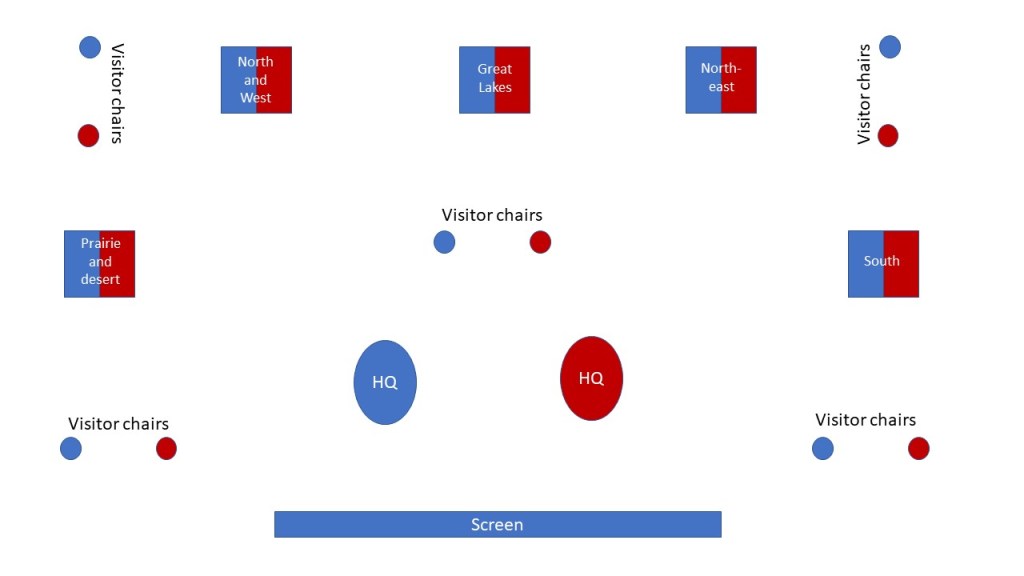
The optimal way for the game experience is simply to use a significantly larger room than you usually would. If you follow the layout of this chart, you can optimize the distance between student groups at all times. By using visitor chairs, it is still clear, when someone visits a state or a region, and you have a way of ensuring their distance from the other group, which standing at a distance does not ensure to the same degree.

You can download a PDF file showing set-up here:

Play safely, 

Malik

PS. Remember you can buy the game at Teachers Pay Teachers.

Sweeping Trump victory in Valletta – or how to get more realistic results in Battle for the Presidency

While I get reports of good learning experiences from students who play Battle for the Presidency, the game has a strong tendency to proclaim Hillary Clinton as the winner. This reflects the general analysis prior to the election, but when the game is played after the election, it seems a bit odd that the wrong outcome is highly predominant.

When I played the game with one of my Danish upper secondary classes and a Maltese junior college class in March, I made a few modifications.

In the following text, I will sum up the modifications I chose to implement for the game, along with a short motivation for each.

1: Secret Trump Voters and Money for Hillary

Since I wanted Trump to have more than just a fighting chance, I added an extra feature. This illustrates the inability of the polls to foretell the number of Trump voters, and at the same time hints at the superior economic capability of the Hillary campaign.

At the beginning of every turn, beginning at turn two, both campaign managers roll a die. Results can be seen on the following chart:

Die roll Area Democrats Republicans
1 None No effect No effect
2 Northeast Regional office gains 3M$ Republicans gain 1 vote in all states in region
3 South Regional office gains 3M$ Republicans gain 1 vote in all states in region
4 Great Lakes Regional office gains 3M$ Republicans gain 1 vote in all states in region
5 Prairie and Desert Regional office gains 3M$ Republicans gain 1 vote in all states in region
6 North and West Regional office gains 3M$ Republicans gain 1 vote in all states in region


2: Added funds for the regional offices

A group of teachers in a neighboring town ran five games in a row and tweaked the rules a bit every time. They found that the game was faster and had more activities for the regional offices, if they had a budget and funds to work with.

So the regional managers got 5M$ each in their war chest at the beginning of the game and an income of 2M$ each turn.


3: Fox and CNN

Since I was running a game for 54 students, there was precious little for each student to do, if we did not add extra activities. Each HQ was enlarged with two extra Communication Experts, so the Campaign Manager had extra eyes and ears, which worked well.

As a more significant game changer, two groups of students were asked to act as news crews for Fox News  and CNN respectively.


In order to make the tasks of the news crews more relevant, they were given notice in advance of the upcoming event, and would then interview representatives of the two parties before and after the reading of the event card.

The news crews were instructed to focus on regions with little action, and in that way provided extra activity without slowing down the game.

Some time had to be taken out for short broadcasts at the end of each turn, however.


All in all, Trump won a comfortable, but not a landslide victory in Valletta, and the students had something to do while they got to know each other.

My experience with Battle for the Presidency so far

Battle for the Presidency is out there, now.

Teachers are mediating games, and students are trying to beat each other irrespective of whether they agree or disagree with the side they play.

If the six games I have played until now are an indicator, Trump, more often than not, will find it hard to collect 270 electorates. That was not prophetic game design – rather an unintended side effect of the relative size difference between the secure states of the two sides.

And it does not change the learning pattern of the game one bit. It is all about playing the game – not about winning it.

When the students play, they make decisions. Some of them are exactly the right decisions at the right time, but wrong decisions or an unlucky timing may give them just the lesson they need. Nobody knows which one is the most important.

It is my experience that all learning takes place in a confusing and disordered environment – not the classroom, but the chaotic reality of 20+ developing adolescent minds. 

We cannot force all of them to stay on track at the same time, but we can make it easier for them. 

The algorithms of a good game tempt you with the chance of winning and the thrill of competition. Furthermore, the game sequence calls everybody back to the learning activity at very regular intervals. 

For the entrepreneurial students, there is a chance of testing out the mechanisms, doing unexpected things, cooking up new strategies. For the less adventurous, there is still the security of rules and purpose.

The role of the teacher also changes. The teacher is  no longer the judge and jury, the employer and the entertainer. Instead, they becomes the mediator of a process, who has to help it along,  but at the same time must accept any action within the set rules.

I hope Battle for the Presidency makes Democrats as well as Republicans wonder about the many states, which have only three electorates; marvel at the seeming randomness in which swing-state suddenly swallows half their budget; and question whether the right issues were chosen for North Carolina.

But even if they do not get that far – hopefully the action and the competition will give them a framework to remember a lot of the basic data in. I design educational games to help students learn. 

My next project is The Scramble for Africa, and I hope to share a lot of my ideas about games and learning when I am closer to publication.